
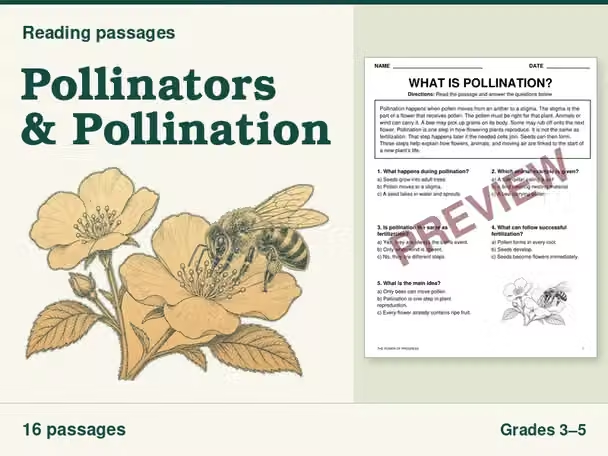
Pollinators and Pollination
- Reading level · Grades 3–5
- Answer key included
Single resource · Grades 3–5 · Reading comprehension · 22 pages · 16 passages · 80 questions
Build plant science knowledge with these Pollinators and Pollination Reading Comprehension Passages and Questions.
Assign available passages online with a website order. How the Reading Room works · See a sample teacher report
About this resource
Students explore how pollen moves, how flowers reproduce, and how animals help plants through 16 short nonfiction passages and 80 multiple-choice questions.
The packet covers flower parts, nectar and pollen, bees, butterflies, moths, hummingbirds, bats, flies, beetles, and wind pollination. It distinguishes pollination from fertilization and follows the steps from pollen reaching a stigma to seed development. Later passages connect pollinators with food crops, habitat needs, and gardens.
What’s included
- 16 nonfiction reading passages, each about 100 words
- 80 multiple-choice questions, with 5 questions per student page and 3 answer choices per question
- 16 illustrated student worksheets in black and white
- Answer keys with the correct letter and answer text
- Teacher directions, a complete passage list, and source notes
- 22 total PDF pages, including the cover and teacher pages
Also available in
Explore related resources
Worksheet preview
22 pages
Read a text excerpt
WHAT IS POLLINATION?
Pollination happens when pollen moves from an anther to a stigma. The stigma is the part of a flower that receives pollen. The pollen must be right for that plant. Animals or wind can carry it. A bee may pick up grains on its body. Some may rub…