
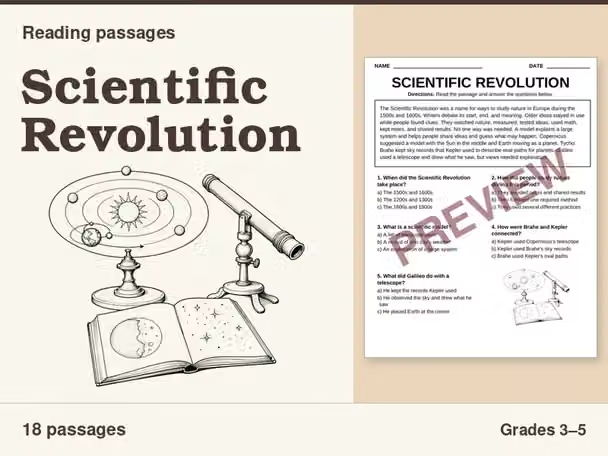
Scientific Revolution
- Reading level · Grades 3–5
- Answer key included
Single resource · Grades 3–5 · Reading comprehension · 19 pages · 18 passages · 90 questions
Explore how Copernicus, Galileo, and Newton contributed to scientific thinking with these Scientific Revolution reading comprehension passages and questions for history and social studies.
Assign available passages online with a website order. How the Reading Room works · See a sample teacher report
About this resource
Use these nonfiction worksheets for sub plans, morning work, early finishers, homework, and independent practice, or to support your Scientific Revolution lessons. This resource includes 18 nonfiction passages, 90 multiple-choice questions, and an answer key in a printable PDF. Recommended for Grades 3–5. Selected passages may also support older learners who benefit from shorter text and focused comprehension practice. Review the preview to check vocabulary, reading demands, and topic suitability for your students.
Topics cover competing models of the solar system, scientific instruments and measurement, motion and forces, anatomy, chemistry, the spread of scientific ideas, and the Galileo Affair. Students read each informational text passage and answer 5 multiple-choice questions using information from the text. The passage and its questions stay together on one page for easy classroom use.
Pair with sentence editing
Fix the Passage | Scientific RevolutionWhat’s included
- 18 nonfiction passages
- 90 multiple-choice questions
- 5 questions per passage
- Answer key
- 19 total pages in a printable PDF
Also available in
Explore related resources
Worksheet preview
19 pages
Read a text excerpt
SCIENTIFIC REVOLUTION
The Scientific Revolution was a name for ways to study nature in Europe during the 1500s and 1600s. Writers debate its start, end, and meaning. Older ideas stayed in use while people found clues. They watched nature, measured, tested ideas, used math, kept notes, and shared results. No…