There are moments when an activity seems to occupy the whole mind. Time feels different. Concern about how we look recedes. Attention settles into what is happening and what comes next.
Flow describes this deep absorption. Action and awareness can feel closely joined: a musician follows an unfolding phrase, or an athlete responds to movement without consciously narrating every decision. Demanding work can feel fluid, and the activity itself becomes rewarding. [1]
What draws me to flow is the possibility of being fully involved. Practiced abilities come together around something that deserves our attention. The satisfaction comes from meeting that demand, giving us a reason to return and develop further.
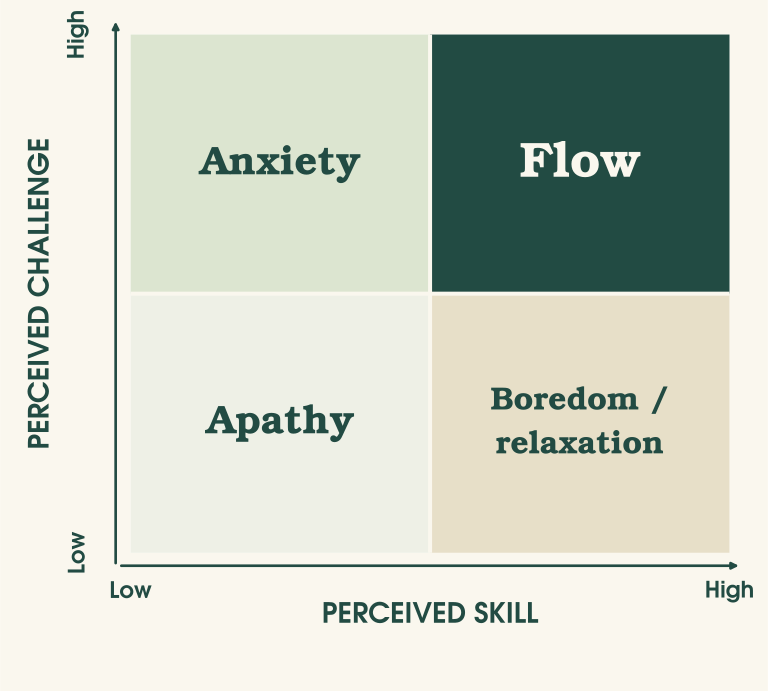
Reading the graph
The graph places perceived skill on the horizontal axis and perceived challenge on the vertical axis. Its four regions describe different relationships between a person and an activity. High and low are relative to the individual. [2]
Apathy: low challenge, low skill. There is little demand or involvement. Attention can drift because the activity offers little reason to engage.
Boredom: low challenge, high skill. The person has more ability than the task requires. This region can also feel relaxing; greater involvement may call for a more demanding goal.
Anxiety: high challenge, low skill. The demands feel beyond the person’s current ability. Preparation, support, or a smaller first step can make the task more approachable.
Flow: high challenge, high skill. The activity stretches developed abilities while feeling manageable. Clear goals and feedback help attention remain absorbed in responding. [2]
The balance keeps moving
What feels like a perfect meeting of challenge and skill is a moving relationship. The graph shows a region in which meaningful demands and the ability to respond come together.
In lacrosse, a stationary passing pattern may absorb a beginner. As catching and throwing become dependable, movement, defensive pressure, and passing choices offer richer challenges. Keeping the activity engaging means noticing when the player is ready for something more.
This helps explain why flow can be elusive. Preparation, motivation, emotional state, and the environment all appear in athletes’ accounts of what influences it. The same task can meet a person differently on different days. [3]
Sustaining absorption also means protecting continuity. Workplace research found that more fragmented days involving numerous tasks were associated with less flow. That offers a reason to examine how often we interrupt a lesson or practice just as someone becomes involved. [4]
Finding a way back
When absorption breaks, a useful place to begin is the next action. Recover the goal, remove an avoidable distraction, and make the demand manageable enough to re-enter.
In reading, that might mean returning to the last idea understood before continuing. On the field, it might mean simplifying a passing activity until players recover its rhythm, then bringing back a decision. These are practical ways to rebuild engagement.
Flow comes and goes. Consistently seeking it means learning to recognize when an activity needs more challenge, more support, or more uninterrupted attention.
The lasting opportunity is to make growth rewarding in itself. Developing a skill opens new possibilities; exploring those possibilities gives practice a purpose. Momentum comes from repeatedly finding work worth becoming absorbed in.
Sources & further reading
- Antonini Philippe et al. Achieving Flow: An Exploratory Investigation of Elite College Athletes and Musicians (2022).
- Nakamura and Csikszentmihalyi. The Concept of Flow (2002). Conceptual model underlying the figure.
- Swann et al. Exploring Flow Occurrence in Elite Golf (2013).
- Pluut, Darouei and Zeijen. Why and When Does Multitasking Impair Flow and Subjective Performance? (2024).
Numbered links identify supporting sources. Practical examples and personal interpretations are identified in the text.

Grounded in practice
Classroom practice and special education studies inform work with gifted learners, students with disabilities, and general education students.
Read the story